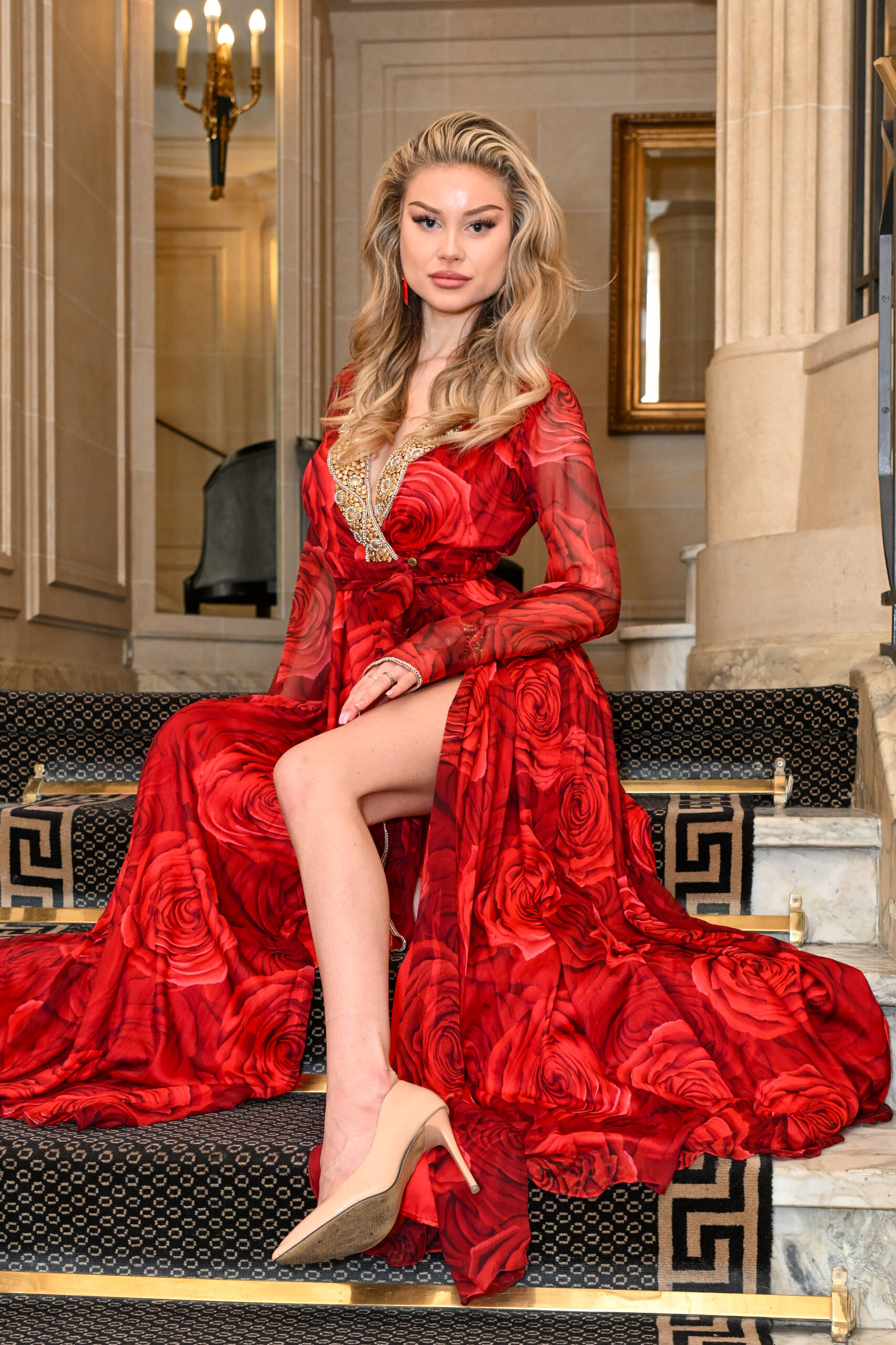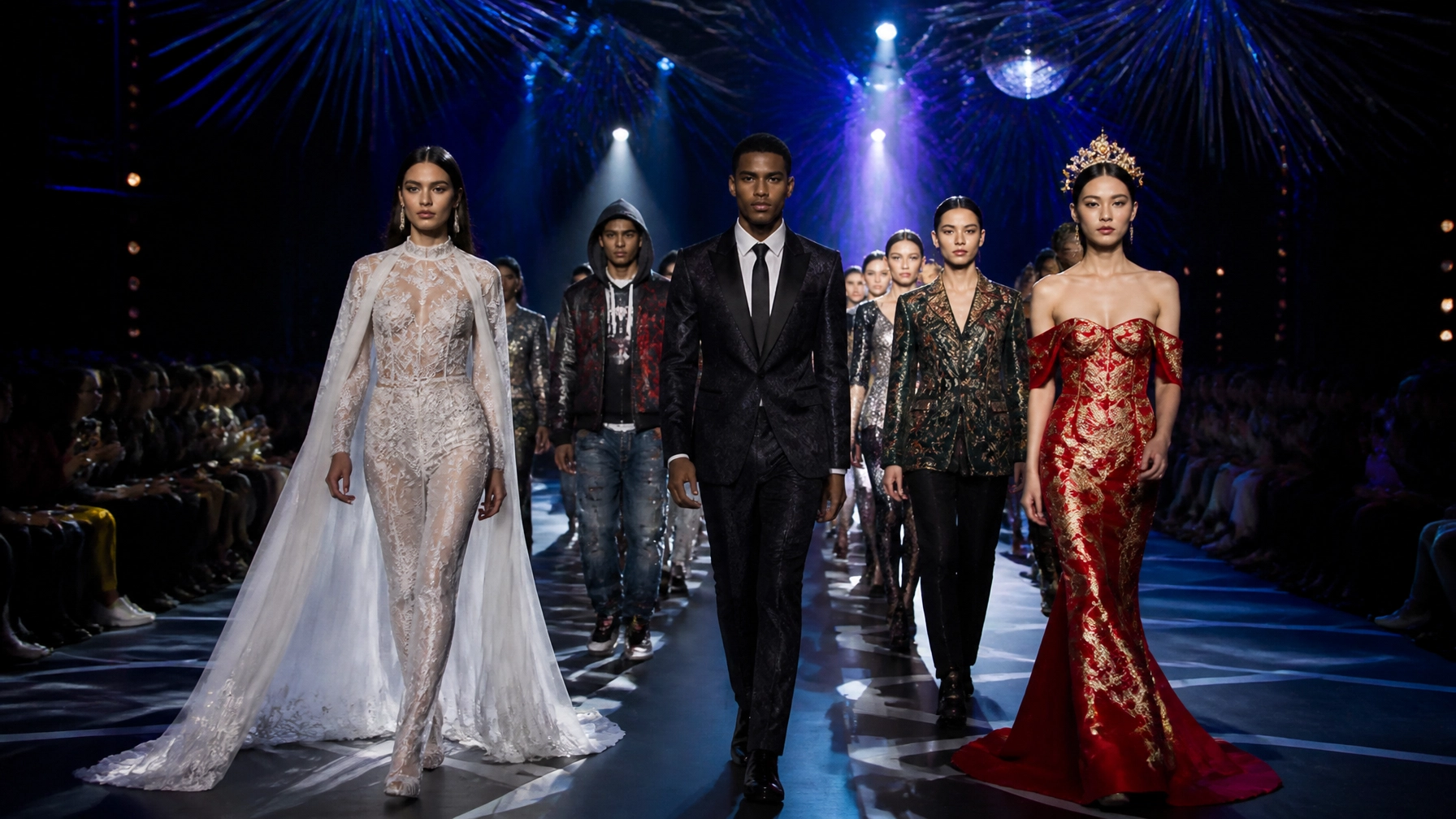
John Galliano’s Zara debut has become the defining fashion news story of Paris Fashion Week’s opening days. Re{form} Vol. 1, the first instalment of a two-year partnership between the legendary couturier and the Spanish high-street giant, launched on October 1 alongside the Spring/Summer 2027 season.
The response is immediate. Queues form outside stores, a guipure dress reportedly disappears within minutes, and online shoppers move quickly through a collection that translates Galliano’s couture vocabulary into Zara’s extensive archive. The result is more than a designer collaboration. It is a live test of how far haute couture can travel without losing its aura.
As reported by The New York Times, Vogue, and other international fashion publications, Re{form} is positioning the high street as a new stage for atelier-level technique. The debate surrounding the launch is already moving beyond clothing: is this a major coup for accessibility, or evidence that luxury’s boundaries are becoming increasingly difficult to define?
Re{form} Arrives in Paris With Immediate Demand
The first collection launches globally on October 1, with a dedicated by-appointment pop-up in Paris running through October 6. The temporary space, staged in a historic hôtel particulier, presents the line as both retail environment and fashion exhibition.
Select flagships in London and Madrid are also carrying the collection. In the United States, including New York, shoppers can purchase Re{form} online only, creating a notable divide between the intimate Paris experience and the wider digital release.
That distinction matters. Galliano’s return is not being introduced through a conventional mass-market launch alone. The Paris presentation gives the collection ceremony, scarcity, and a sense of occasion, while Zara’s global e-commerce network supplies the reach. The model merges the mechanics of a high-street drop with the theatrical control traditionally associated with luxury fashion brands.
Within days, approximately 86 of 209 listed products are reported to have sold out, representing roughly 41.5 percent of the assortment. The figure is a moving snapshot rather than a final official sell-through report, but it captures the speed of the reaction. Several pieces disappear in multiple sizes, while reports of queues and rapid sellouts reinforce the impression that Re{form} is operating as a cultural event as much as a commercial release.
The demand also reveals an important shift in fashion consumption. The audience is not waiting for a traditional runway show 2026 moment to determine desirability. Product pages, social feeds, store queues, and resale conversations are creating momentum in real time…
Galliano Rebuilds Zara’s Archive Through Couture Technique
The central idea behind Re{form} is not simply that John Galliano has designed for Zara. It is that Galliano is deconstructing and rebuilding Zara’s own archive through couture methods.
That distinction gives the collaboration its intellectual force. Rather than imposing an unrelated designer signature on a mass-market base, the project examines what already exists inside Zara’s design and production history. Familiar references are cut apart, reshaped, layered, embroidered, and reconstructed until they occupy a new visual register.
The process places proportion and construction at the center. Tailoring becomes more sculptural. Eveningwear carries the tension of theatrical dressing. Lace, draping, surface treatments, and precise finishing suggest the hand of the atelier, even when the original point of departure is a high-street garment.

This archive-meets-atelier approach connects directly to the latest haute couture trends. Across Paris, designers are treating archives as active design material rather than static heritage. Historical silhouettes are being softened, engineered, enlarged, or stripped back to create new forms of relevance.
Galliano’s Re{form} applies that logic to Zara, turning a commercial archive into a site of experimentation. The implication is significant: couture technique is no longer presented as something that belongs exclusively to a rarefied house. It becomes a method that can be translated, scaled, and circulated through a much broader retail system.
The line therefore sits between categories. It is not haute couture in the legal or traditional sense. It is not conventional fast fashion either. Its significance lies in the tension between those two descriptions.
The Price Question: Accessibility or a New Luxury Tier?
Re{form} is priced from roughly $30 to $930, with several standout pieces clustered between approximately $750 and $1,000. That range is central to the public discussion.
At the lower end, the collection appears to offer a direct point of entry into Galliano’s world. Accessories and simpler wardrobe pieces create the impression of access. At the upper end, tailored garments, elaborate dresses, and technically demanding pieces approach the price territory traditionally occupied by contemporary designer labels.
The reaction is already being summarized by one recurring concern: “Our pants will now cost $200.” The statement captures the uncertainty around Zara’s new positioning. Consumers may welcome greater access to a celebrated designer’s ideas, but the partnership also raises questions about whether high-street pricing is being stretched toward a premium tier without fundamentally changing the expectations around production, durability, or transparency.
Coverage from W Magazine and Fashionista reflects the same tension. Re{form} is more reachable than a Galliano couture garment, yet it is clearly not priced like an ordinary Zara purchase.
Accessibility, in this context, has several meanings. A piece may be technically available to a global audience while remaining financially out of reach for many shoppers. It may be sold online across markets while disappearing quickly from stock. It may offer an affordable entry point at $30, even as the most visibly couture-inspired garments approach four figures.
That contradiction is not a flaw in the conversation; it is the conversation. Re{form} is exposing the distance between availability and affordability, two ideas that are often treated as interchangeable.
The Met Controversy Adds Another Layer
The launch also arrives after the recent Met controversy surrounding Galliano, giving the collection a more complicated cultural context. The press discussion has largely framed the partnership as a question: terrible idea or major coup?
That framing allows the debate to remain open. Galliano’s influence on fashion history is extensive, and his technical authority remains central to the collection’s appeal. At the same time, the industry is increasingly attentive to ethics, accountability, institutional choices, and the responsibilities attached to creative power.
Zara’s decision to launch the partnership during Paris Fashion Week intensifies the symbolism. The collaboration places a contested but highly influential designer at the center of a global fashion conversation, while giving the world’s largest fashion audiences immediate access to the result.
It also underlines how fashion’s changing media landscape can compress complicated discussions into a single viral drop. A product sells out, a queue becomes an image, a price becomes a debate, and a designer’s legacy is reconsidered through the speed of online attention…
Why the Collection Matters to Luxury Fashion Brands
Re{form} arrives at a moment when luxury fashion brands and mass-market players are moving closer together. Heritage houses are expanding into lifestyle, beauty, digital experiences, and more accessible product categories. High-street retailers are recruiting celebrated designers, investing in cinematic campaigns, and creating temporary environments that resemble luxury presentations.
The distinction between the two sectors is therefore becoming less dependent on price alone. Craft, scarcity, storytelling, cultural prestige, and distribution are now being combined in new ways.

The strategy is visible across current designer collections. Luxury houses are using their archives to create fresh relevance, while mass-market brands are borrowing the language of exclusivity. The result is a marketplace where a product’s meaning may depend as much on its narrative and launch environment as on its label.
Runway Fashion Collective’s recent analysis, “Luxury Fashion Brands Are Evolving: 7 Designer Collections Set to Define 2026,” examines a similar movement across couture: heritage is increasingly treated as raw material for reinvention.
Re{form} extends that evolution beyond the traditional luxury system. Galliano’s project suggests that the future of couture influence may not belong only to couture houses. It may also appear through partnerships with companies capable of translating atelier thinking for millions of customers.
The High Street Becomes a New Fashion Laboratory
The most consequential aspect of Re{form} is not the collaboration’s novelty. Designer and retailer partnerships have become common. Its importance comes from the way it reframes the high street as a design laboratory.
Zara is no longer functioning solely as a fast-moving retailer responding to runway signals. Through Galliano, it becomes a platform for historical analysis, technical reconstruction, and fashion authorship. The brand’s archive becomes a source of material rather than a record of past commercial cycles.
That shift will be closely watched by the industry. If the first instalment continues to sell through at this pace, other mass-market players may pursue similarly ambitious relationships with established designers. Heritage houses, meanwhile, may need to clarify what remains uniquely valuable about their own production systems.
The next stage of luxury may depend less on keeping design ideas distant and more on controlling how those ideas are translated. Craft, provenance, exclusivity, and ethical production will remain important, but their relationship to scale is changing rapidly.
The conversation connects with themes visible throughout Runway Fashion Collective’s New York Fashion Week September 2026 schedule guide, where established labels, emerging designers, and changing definitions of American luxury share the same calendar. It also echoes the [Miami Swim Week 2026 trend recap], where swimwear moves toward occasion dressing, cinematic presentation, and a more elevated lifestyle position.
What Comes Next for Re{form}
The first instalment is only the beginning of a two-year partnership. That timeline gives Zara and Galliano room to develop the project beyond the initial impact of the launch.
The questions now extend to the next release: Will the pricing structure shift? Will production expand? Will the couture techniques become more visible, more refined, or more commercially controlled? And can the collection maintain cultural relevance after the first wave of sellouts and social attention fades?
For now, Re{form} is revealing a fashion system in transition. It is bringing couture language to the high street, introducing high-street archive material into an atelier conversation, and forcing consumers to reconsider what accessibility actually means.
The launch does not resolve the tension between prestige and reach. It makes that tension impossible to ignore. As Paris Fashion Week continues and the runway calendar moves toward the next major designer collections, John Galliano’s Zara debut is establishing one of the clearest signals of fashion’s 2026–2027 landscape: the future of luxury may be less about fixed categories than about who controls the translation between them…